Showing posts with label conservation. Show all posts

Saturday, March 18, 2017

interview


Students in the Broadcast Media program of FIU's School of Communication + Journalism came to tin box a few weeks ago to shoot footage for a class project on renewable energy. Their finished project is pretty good. Forgive the small video - Blogger restricts file sizes, so the video here is a little small.
The two students leading the project–Erica Santiago and Diana Guarnizo–are also producing a longer video that explores larger questions of social and ecological sustainability at tin box. We look forward to posting that later this spring!


Sunday, March 10, 2013

driving lessons

Last night, somewhere on I-75, the odometer on our 2007 Prius crossed the highly symbolic, yet utterly unimportant, 100,000 mile threshold. To mark the event, we’re listing the lessons learned from the car, and how they influenced the design of tin box...

Sunday, October 23, 2011

props for Tricky Dick

Could Richard Nixon get the Republican presidential nomination these days? Whatever else Nixon was responsible for, he also signed into law some of our country’s foundational environmental legislation, including the National Environmental Policy Act (1969), the Clean Air Act (1970), the Clean Water Act (1972), and the Endangered Species Act (1973). Without Nixon, many of our iconic animal species – bald eagles, alligators, bison – would be extinct. Remember back when you couldn’t see the Los Angeles skyline through the smog, or when the Cuyahoga River caught fire? Take a deep breath and thank Richard Milhous Nixon.

Saturday, October 22, 2011

urgency

An important new report this week gives new urgency to our efforts to slow the pace of climate change. Richard Muller, a physics professor at Berkeley whose critiques of climate science have earned considerable support among climate change deniers, released the results of a two-year study of surface temperature data  from the last two hundred years. His conclusions? The earth is warming, and the pace of warming is increasing at a disastrous pace. As Kevin Drum writes in Mother Jones, not only is the rate of warming accelerating, but Muller's findings are even more alarming than those of some of the other scientists whose methodologies he faulted.

Tuesday, September 20, 2011

shade

The cheapest technology in the house is borrowing shade from existing trees. We deviated from the US Green Building Council's LEED standards when we included lots of glazing on walls that face east and west. LEED's concern is that the low sun in the morning and afternoon brings excessive heat into a building during the hot months. We recognized, however, that the existing trees in the park to the west would provide a lot of shade in the afternoon, while our east neighbor's trees would shade the house in the morning. The photo at left shows the living/dining room shaded by existing trees, even before we add the roof panels.

Thursday, September 8, 2011

lighting

Consumer Reports has a great article on light bulbs, which includes some of the most extensive testing yet of light-emitting diode (LED) bulbs, a few weeks after a good comparative essay on bulbs in the New York Times. The good news is that commercially available LED bulbs are both reliably durable and pleasant to the eye. We suspect that, like compact fluorescent bulbs (CFLs), LEDs are going to quickly become popular with consumers (except for a small segment of tin-foil hat types who associate LEDs with a government plot to take away their guns, bibles and/or medications), and that their price will drop markedly. We are planning to use LED replacement bulbs in conventional track lighting fixtures in the kitchen, and living and dining rooms. We still haven't settled on a strategy for lighting the dining table, but friend of tin box Cathy Bell reminds us of these compelling beauties from Plumen.

Tuesday, September 6, 2011

water, too little

What if tap water was as expensive as gasoline? This was the premise of a report on WLRN radio this morning, and in the Miami Herald last week. Towns in South Florida face increasing difficulty drawing fresh water from the Biscayne Aquifer – the only source of drinking water for four and a half million of us in Dade, Broward and parts of Palm Beach Counties – which is suffering from increasing intrusion of salt water from the bay and ocean. (And it's far worse in Texas, where the drought is killing crops and helping the spread of wildfires.) The problem grows from a confluence of issues:

Friday, September 2, 2011

redefine performance

mpg or mph?
Monitoring performance seems to be an important aspect of sustainability. Measuring resource consumption helps promote conservation, both because we use less when we can monitor it, and because good performance data in existing buildings is essential to improving the design of future buildings.

But how do we measure performance?

Tuesday, August 9, 2011

embodied energy and energy use

“Statistics are merciless things.” Le Corbusier, The City of To-morrow and its Planning, 126.

The Department of Energy has posted a lot of useful data on energy use in the United States, which helps identify the low hanging fruit for big gains in energy efficiency. Some of the key take-aways: Americans consume one fifth of the world’s energy. Two-fifths of that energy is consumed in and by buildings, with 22% going into our houses. 91% of that energy produces carbon or radiation. And, most depressingly, nearly half our energy is lost in transmission and distribution.

Friday, July 22, 2011

what you don’t see

Notice the conspicuous absence of a dumpster.

One big advantage to prefabrication is that it significantly reduces construction waste. The primary structure is nearly complete, and so far the crew has only had to dispose of a few tiny pieces of scrap steel. The foundation and slab were poured with a minimum of waste (most of the wood forms were taken away to be reused) and the utilities were roughed in with only a couple of cardboard boxes worth of scrap pipe needing to be carted away.

about that tree

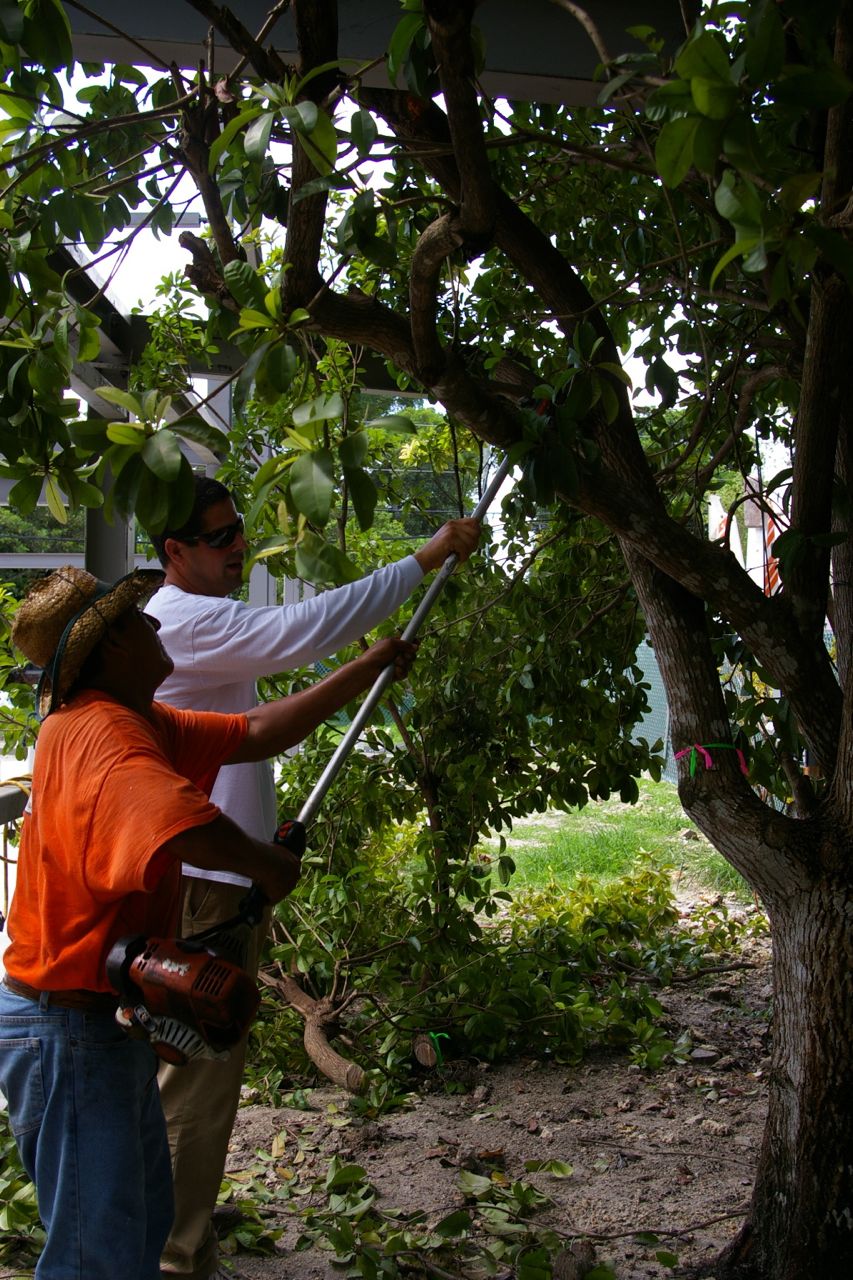
Daniel Macias stopped by the site today to supervise the trimming of our sapadillo (or sapote) tree. Danny owns The Billy Goat, and has been maintaining the grass around our site during construction (they also maintained the yard around the previous house on the site before we started construction). They’re helping us preserve as much of the sapadillo as possible. This tree, along with the big avocado in the back yard, were part of the plan of tin box from the beginning. The sapadillo works with the cantilevered roof to frame the patio space facing the park across the street, and also helps hide the big electric pole just outside our living room. It’s a beautiful tree, and, if we’re lucky, it might start producing fruit.

Tuesday, April 26, 2011

unintended irony

Miami has some quirky habits. One is parking on the lawn (or at least the strip of grass between street and sidewalk referred to as "parkway" on site surveys). Another is dumping big piles of trash and yard waste along the side of the road.

Our house used to have a big trash pile in front of it, but the neighbors have stopped using our lot as a dumping ground since we started construction. And to a large extent the construction has minimized the amount of dog poop accumulating in front of the house. But these ever-present dumping piles raise a good question: how much stuff do we throw away?

Is it necessary to generate so much refuse in the course of everyday life? What techniques can we use to stop bringing stuff into our homes just so we can dump it out front a few hours later? What does it say about our regard for public space that we don't hesitate to dump trash out on the street?

update: tin box just recorded its 2,500th page view. Thanks for your input so far. Let us know what topics you'd like us to cover in future posts.

Monday, April 25, 2011

best practices

A very helpful document from the Department of Energy (who also sponsor the Solar Decathlon competition) which we've been consulting is Building America Best Practices Series: Volume 1. Builders and Buyers Handbook for Improving New Home Efficiency, Comfort, and Durability in the Hot and Humid Climate. It is available online as a free PDF file.

Tuesday, April 19, 2011

the third shoe falls

Big plumbing stuff keeps arriving, unexpectedly. This time, it is the graywater filtration tank, which is made by Brac Systems, in Montréal. The tank wasn't supposed to get here until the garage was ready. But then again, the same was true of our rainwater filtration equipment. Our living room is getting crowded.

The item we needed from Brac, was the sump pump (see photo after the break).

red, white, blue and purple (plumbing, p.4)

A closer look at the rough plumbing. A normal house would have one set of big PVC pipes for waste, and two sets of smaller copper pipes for hot and cold water. What's different here? A few things...

Friday, April 15, 2011

purple (plumbing, p.2)

As we noted the other day, there are two sets of drain lines in the house. The regular waste lines leading to the septic system are white PVC. The drain lines leading from the bathtubs and showers to the graywater tank are PVC painted purple, which, apparently, is now the international color code for graywater.

Thursday, April 14, 2011

the other shoe falls

Ok, so remember back 24 hours ago when we came home to a pile of boxes we weren't expecting, and were glad that nothing bigger arrived...?

Well, something bigger arrived. Fortunately, it wasn't the 3,000 gallon cistern, which is slightly larger than our car. Today's arrival is a pre-assembled purification skid. It's got a pump and three filters - a string filter, an ultraviolet light and a charcoal filter. The rainwater will enter through the pump (lower right) and exit after passing through the carbon filter (to the left).

plumbing

Our plumber has started laying the waste lines that will sit under the floor slab. The photo to the left shows the main waste line running across the house, from east to west, then passing under the wood formwork (at which point it will connect to the new septic system). Like all the waste and gray water lines in the house, this one has to slope downward so that gravity and water can do their thing. The PVC pipe will be surrounded with clean fill (sand without rocks in it) so that there aren't any sharp or hard objects that can pierce the pipe after the weight of the slab starts sitting on it.


Monday, April 11, 2011

successful failure

One of the recycled materials we wanted to use in tin box was shredded tire. Used tires are a nasty waste product, but in recent years Florida and a few other states approved the use of shredded tires as a replacement for gravel in places like septic drain fields. We wanted to do just that, but after a little research, we found that waste tires are getting snatched up for more lucrative uses: playground mulch and cement plant fuel. This, of course, is disturbing to us at one level - we won't get to use tires, dagnabit! - but deeply satisfying at another - recycling tires has become profitable, with several industries competing to purchase what was once a semi-toxic landfill material.


Wednesday, March 16, 2011

Fukushima and us


The continuing nuclear disaster unfolding in northern Japan makes our efforts to reduce our dependence on the electrical grid a little more urgent. In a general sense, it's important for us to limit our use of utility-generated electricity because of the numerous ways this energy source damages the environment and public health. But in a more direct way, our efforts will help prevent the construction of two new nuclear reactors in South Florida. More on that in a minute.

But first, the most important thing we're doing is not our photovoltaics. It's conservation. Every watt saved is a watt generated, or at least obviates the need to generate that watt.